
Engineered Rapid Prototypes & Precision Components
Examine our high-performance additive and subtractive product lines manufactured to reduce design iterations, eliminate expensive initial tooling, and accelerate market release.








Redefining "Cheap 3D Print Prototype": Maximum Value via Minimum Waste
In advanced contract manufacturing, the word "cheap" should never indicate low quality or fragile parts. Instead, it signifies ruthless elimination of structural overhead, zero hard-tooling amortization, and near-net-shape additive consolidation.
Zero Tooling Amortization
Traditional metal stamping and injection molding require upfront mold fabrication costs ranging from $5,000 to $80,000, stalling innovation. Industrial 3D printing bypasses tooling completely, allowing engineering iterations directly from digital STEP files within 24 hours.
Zero CapEx Immediate TurnaroundNear-Net-Shape Powder Economy
Subtractive milling from a monolithic billet of Titanium or Inconel can result in a buy-to-fly waste ratio exceeding 85%. Laser Powder Bed Fusion (LPBF) fuses only the exact geometry required, sifting and recirculating unsintered powder for over 95% material efficiency.
>95% Powder Reusability Scrap ReductionMulti-Component Consolidation
By leveraging generative design and topology optimization, our engineering team condenses multi-piece mechanical assemblies into monolithic printed geometries. This eliminates weld lines, braze joints, O-ring sealing grooves, and secondary fastener inventories.
Leak Elimination LightweightingHybrid Production Architecture
We do not force 3D printing on features where simple subtractive CNC is faster and more cost-effective. We print organic internal channels and undercuts, then transition to 5-axis CNC machining cells to finish mating datums and bearing bores down to ±0.005 mm.
±0.005 mm Precision ISO 2768-mChina Factory 4.0: Supply Chain Resilience & Structural Efficiency
Located in the industrial epicenter of Dongguan, TC Precision leverages China’s premier advanced manufacturing ecosystem to deliver unprecedented speed and economic advantages to global hardware pioneers.
Hyper-Clustered Raw Material Alliances
Our facility is situated minutes away from specialized aerosol gas-atomization metal powder suppliers and alloy smelters. This localized supply chain ensures direct sourcing of vacuum-melted CuCrZr, Ti6Al4V Grade 5, 316L, and AlSi10Mg powders with verified particle size distribution (PSD 15-53 µm) at zero transport markup.
By eliminating maritime logistics friction for raw stocks, our powder inventory turns over weekly, preventing moisture contamination, oxidation, and gas entrapment inside the build chambers.
Integrated Hybrid Operations Under One Roof
Subcontracting post-processing is the number one cause of production delays and quality drift in rapid prototyping. TC Precision executes wire-EDM plate separation, thermal stress-relief vacuum annealing, 5-axis CNC secondary finishing, and robotic bead blasting inside a single 3,000 m² ecosystem.
Our engineers set datums directly inside CAM during the slicing phase, eliminating datum translation errors when moving unmachined additive prints onto CNC chucks.
Dark Factory 24/7 Automated Build Shifts
Our multi-laser LPBF machines run continuous automated production cycles. High-capacity inert gas re-circulation (Argon / Nitrogen) systems and automated powder sieving ensure minimal human intervention during build cycles, cutting labor costs while guaranteeing lot-to-lot repeatability.
European and American engineering teams wake up to inspected First Article Inspection (FAI) dimensional reports before standard domestic machine shops have even quoted the tooling stock.
Technology Roadmap & Next-Generation Additive Science
We invest heavily in state-of-the-art optical laser engines, generative computational slicing, and in-situ melt pool diagnostics to push metallurgical boundaries.
515 nm Green Laser Copper Melting
Standard infrared (1064 nm) lasers exhibit less than 5% absorption in pure copper, causing catastrophic back-reflection, spatter, and porosity. Our proprietary 515 nm green-light optical engines achieve >40% energy absorption, yielding >99.8% dense OFHC copper thermal components.
Pure Copper IACS >100% ConductivityAI In-Process Closed-Loop Monitoring
Integrating high-speed optical photodiode arrays and pyrometric sensors inside the optical train, our systems monitor thermal melt pool signatures at 100 kHz. Any layer deviation triggers instantaneous real-time laser power correction, suppressing keyhole pores before solidification.
Zero Porosity Automated Defect TaggingVolumetric & Continuous Multi-Material AM
Moving beyond single-powder boundaries, our research roadmap incorporates multi-material functional gradation (e.g., transitioning seamless copper cores into stainless steel corrosion jackets) and layerless volumetric holographic photopolymer curing for ultra-rapid elastomeric prototypes.
Gradient Metallurgy Isotropic StrengthTailored Solutions for Demanding Industrial Sectors
From extreme thermodynamic requirements to dynamic mass reduction in robotic limbs, our additive and multi-axis CNC cells resolve complex mechanical constraints across global verticals.
Robotics & Humanoid Actuation
Robotic joint assemblies demand low rotational inertia, thin-wall structures, and high yield strength. We manufacture hollow cycloidal drive housings, harmonic gear rings, and bionic titanium limb brackets with integrated cable routings, reducing dynamic payload strain.
- Topology-optimized Ti6Al4V arm brackets
- Weight reduction up to 45% vs. solid billet
- Press-fit bearing bores honed to ISO H7
Electric Vehicle & Thermal Management
Thermal runaway prevention and high power-density inverter cooling demand intricate geometries impossible to cast or extrude. We fabricate pure copper induction coils, liquid-cooled cold plates, and multi-channel heat exchangers with conformal fluid passages.
- Helical cooling microchannels down to 0.8 mm
- Hermetically sealed proof-tested to 25 bar
- High electrical conductivity & thermal flux
Automotive & Precision Power Gears
Rapid functional testing of transmission architectures requires high hardness and pitch circle concentricity. We mill, print, and finish spur gears, helical planetary gears, and spline shafts using carburized alloy steels, balancing impact absorption and surface wear life.
- Gear tooth surface grinding to AGMA Class 11
- Case hardening via vacuum carburizing (HRC 58-62)
- Elimination of prototype broaching and hobbing dies
Industrial Fluidics & Hollow Bent Pipes
Complex manifolds that transport cooling lubricants or corrosive chemicals often suffer from joint failure when welded. Our 3D printed hollow bent pipes in 316L stainless steel provide unified laminar flow channels, preventing boundary layer turbulence and pressure drops.
- Seamless variable-diameter ducting
- Smooth electropolished internal surface finishes
- Threaded CNC ports and O-ring face milling
Engineering Material Science & DFM Decision Matrix
Selecting the ideal additive or subtractive pathway requires balancing mechanical yield strength, thermal dissipation, geometric complexity, and relative cost index.
| Material Grade | Primary Technology | Yield Strength (MPa) | Thermal Cond. (W/m·K) | Key Engineering Applications | Relative Cost Index |
|---|---|---|---|---|---|
| Pure Copper (Cu ≥ 99.9%) | Green Laser LPBF | 190 - 230 | ~395 | Semiconductor cold plates, EV busbars, heat sinks | $$$$ |
| Ti6Al4V (Grade 5 Titanium) | LPBF / 5-Axis CNC | 830 - 910 | 6.7 | Aerospace bulkheads, surgical robots, bionic arms | $$$$ |
| AlSi10Mg Aluminum | LPBF Additive | 230 - 270 | 130 - 150 | Lightweight automotive brackets, drone chassis | $$ |
| 6061-T6 / 7075 Aluminum | 5-Axis CNC Milling | 276 / 503 | 167 / 130 | Enclosures, precision optic plates, test jigs | $ |
| 316L Stainless Steel | LPBF / CNC Hybrid | 480 - 550 | 16.3 | Food equipment, bent pipes, marine manifolds | $$ |
| 20CrMnTi / 4140 Alloy Steel | CNC Turning & Hobbing | 850 - 1100 | 42 | Power transmission gears, splines, drive shafts | $$ |
| Continuous Carbon Fiber / PA12 | SLS / FDM Composites | 140 - 210 | 0.25 | Assembly jigs, robot grippers, CMM inspection nests | $ |
Addressing Enterprise Procurement Needs & Risk Mitigation
Procurement executives balancing budget caps and strict launch milestones face severe risks when outsourcing across borders. We eliminate foreign sourcing uncertainties through radical transparency, rapid feedback, and binding accountability.
Rigorous DFM Engineering Feedback Loops
Within 2 hours of receiving your 3D CAD models (STEP, IGES, Parasolid, or STL), our senior manufacturing engineers deliver a comprehensive Design for Manufacturability review in native English. We identify unmachinable internal radii, support-stress risks, thin-wall warpage risks, and recommend parameter tweaks that directly slash machine cycle times and cut unit costs.
Tiered Volume Pricing with Zero MOQ
We do not penalize innovation with prohibitive Minimum Order Quantities. Whether your team requires an exploratory 1-piece aesthetic prototype, an engineering validation batch of 25 units, or a pilot bridge run of 2,500 units, our machine schedules adapt dynamically with clear, unbundled unit costs.
Strict NDA & Intellectual Property Shield
We treat client data as top-tier proprietary intellectual assets. Before sharing CAD models, mutual non-disclosure agreements are signed with international legal standing. All CAD data is held in air-gapped, encrypted servers and permanently purged upon project completion at your request.
Global Compliance, CMM Inspection & Export Assurance
Every millimeter of every critical feature is verified against your 2D engineering drawings. Our quality control lab bridges European and American regulatory compliance seamlessly.
Certified Quality Management
Our quality management system is aligned with ISO 9001:2015 frameworks. Every step—from raw powder lot inspection to final surface treatment—is digitally documented. Raw material chemical mill test certificates (MTR) and European RoHS/REACH compliance letters accompany all overseas shipments.
Zeiss CMM Dimensional Verification
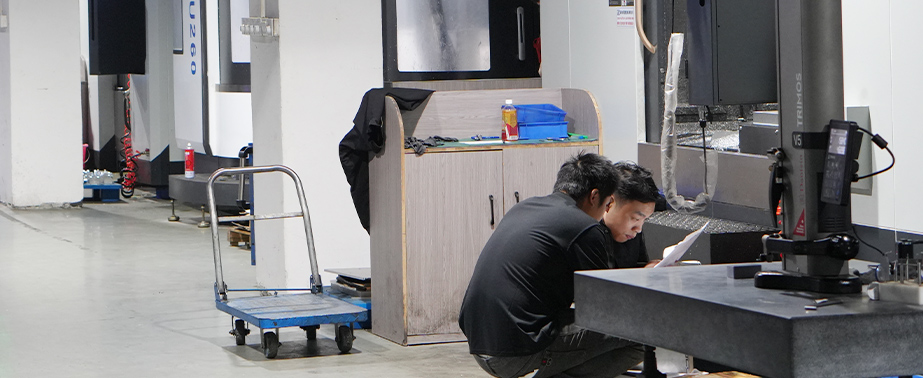
Parts requiring tight tolerances are validated in a climate-controlled inspection suite featuring high-precision Zeiss Coordinate Measuring Machines (CMM), optical contour projectors, and surface roughness profilometers. Full GD&T inspection reports are delivered with every order.
Export-Grade Vacuum & Corrosion Packaging
Protecting precision-machined threads and oxide-sensitive copper during intercontinental transport is paramount. Parts are ultrasonic-cleaned, sealed with vapor corrosion inhibitors (VCI), enclosed in custom laser-cut foam inserts, and shipped via expedited air express (DHL/FedEx/UPS) in under 3-5 days globally.
Trusted by Global Hardware Innovators, Robotics Labs & Automotive Tier-1 Suppliers





Engineering Case Studies from our Dongguan Production Floor
Discover how our hybrid LPBF and 5-axis subtractive production workflows solve extreme design challenges under tight budgetary and schedule constraints.
Hybrid Additive + 5-Axis Milling Cell
Complex aerospace bracket fabricated via near-net shape LPBF in AlSi10Mg, followed by 5-axis CNC machining of bearing bores down to ±0.005 mm. Cut cycle time by 60% compared to milling from a 45 kg solid billet.
Automated Actuator Housings
Precision CNC turning and mill-turn operations for high-speed robotic drive couplings in hardened alloy steel. Achieved concentricity tolerances within 0.008 mm with electroless nickel protective plating.
Bionic Robot Arm Titanium Joints
Topology-optimized internal lattice skeletal joint printed in Ti6Al4V Grade 5. Weight reduced by 48% while maintaining dynamic stiffness above 12 kN/mm. Thermal stress-relieved in vacuum furnaces.
High-Flux Pure Copper Cold Plate
Manufactured using 515 nm green laser LPBF for an electric hypercar cooling manifold. Achieved 99.85% metallurgical relative density, zero coolant leakage at 30 bar hydro-testing, and >390 W/m·K thermal dissipation.
Frequently Asked Questions by Sourcing & Design Engineers
Detailed answers regarding tolerances, material characteristics, pricing models, and production logistics to help you make informed procurement decisions.
How can a Chinese 3D print prototype manufacturer offer such low prices without compromising metallurgical quality?
Why is a 515 nm green laser required for pure copper 3D printing instead of standard fiber lasers?
What tolerances and surface roughness can TC Precision hold on finished prototype components?
What is your standard protocol for intellectual property protection and file privacy?
What CAD file formats and 2D documentation are required for a DFM review and quotation?
How do you prevent internal cracking and residual thermal stress in titanium and copper additive parts?
High-Demand Prototyping & Production Catalog
Explore additional specialized components manufactured using our advanced multi-axis CNC machines and metal LPBF 3D printers, engineered for immediate commercial deployment.


Request an Expert DFM Review & Instant Quote
Send your CAD models today. Our senior additive engineers will analyze your geometries, recommend optimal build orientations, minimize support waste, and provide a competitive, unbundled quote in under 2 hours.